

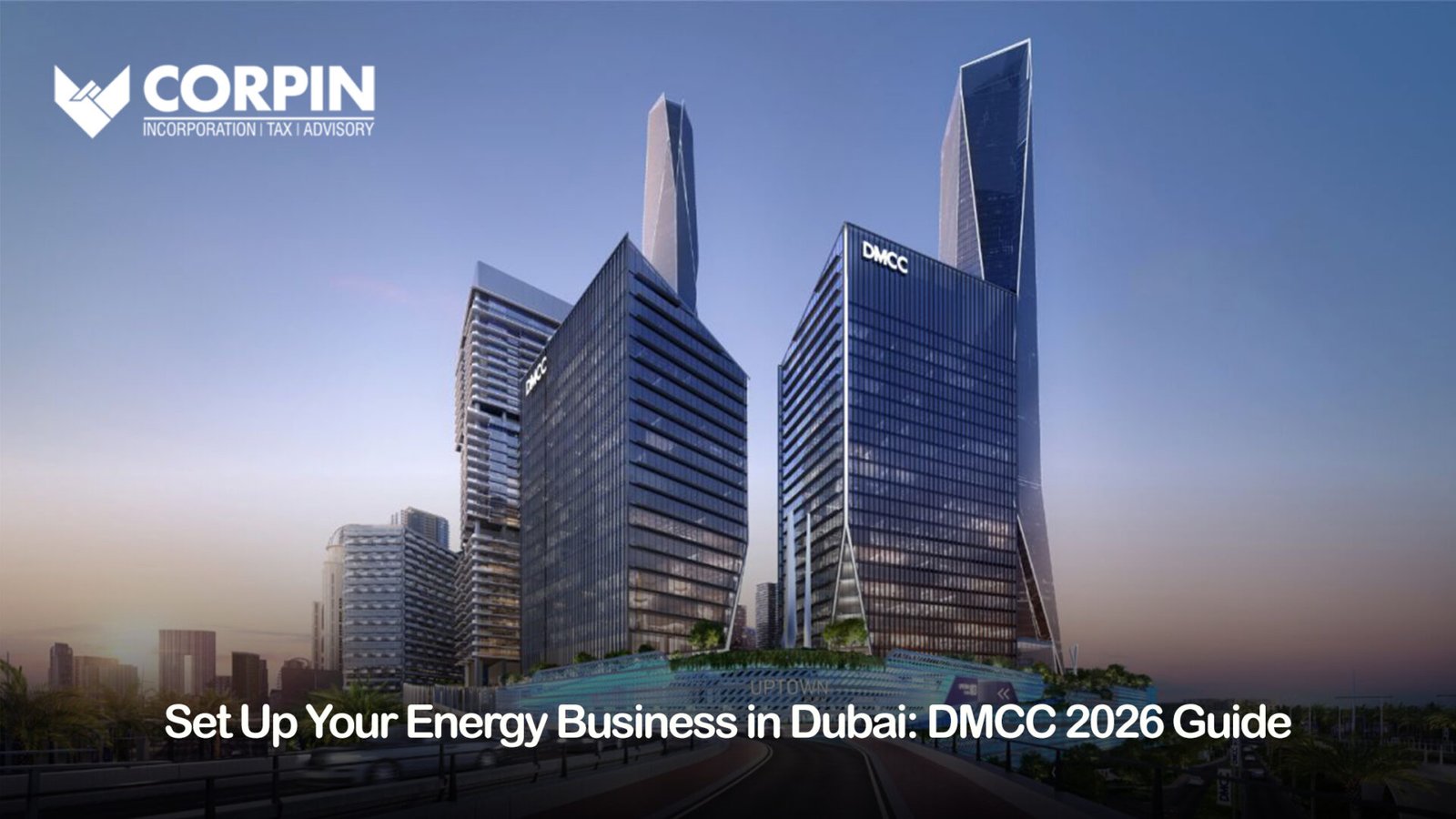
Setting up an energy business in Dubai requires aligning your corporate structure directly with your revenue model. Whether your business focuses on physical petroleum trading, solar equipment distribution, or clean energy consulting, licensing and operational needs vary significantly across the UAE market.
For international energy firms and entrepreneurs, the Dubai Multi Commodities Centre (DMCC) provides an established hub for conventional fuels, renewables, and emerging energy tech.
This guide outlines how to set up an energy business in DMCC in 2026, covering activity mapping, budgeting, banking, and tax compliance.
How to Set Up an Energy Business in DMCC 2026
To set up an energy company in DMCC in 2026:
- Map activities: Identify precise commercial codes (general trading excludes oil and gas).
- Choose ownership: Select individual, corporate, or branch structure.
- Budget costs: Account for standard fees starting at ~AED 34,180 (excluding office and visas) plus AED 50,000 standard minimum share capital.
- Prepare banking & tax: Align counterparty documentation early and evaluate Qualifying Free Zone Person (QFZP) status for 0% Corporate Tax eligibility.
- Timeframe: Digital incorporation takes approximately 2 weeks once documents are approved.
Why Choose DMCC for Your Energy Company?
DMCC anchors energy businesses within a global commodities trading ecosystem. Its coverage spans:
- Conventional Energy: Crude oil, refined petroleum, natural gas, LNG, and petrochemicals.
- Renewables & Clean Tech: Solar PV, wind turbine equipment, biofuels, hydrogen, and battery storage.
- Services: Technical consultancy, project management, and intermediary brokerage.
Members gain access to the DMCC Energy Club, a dedicated industry network connecting traders, producers, project developers, and equipment suppliers across the MENA region.
Key Energy Business Activities in DMCC
Choosing the correct activity code during incorporation is critical. DMCC enforces specific licensing criteria depending on whether you take title to physical goods, broker transactions, or offer advisory services.
DMCC Energy Activity Breakdown
| Business Model | Core Focus Area | Key Approval Requirement |
| Energy Commodity Trading | Buying & selling oil, gas, or refined fuels | Specific licence required (General Trading excludes oil/gas) |
| Renewable Equipment Trading | Distributing solar panels, batteries, inverters | Standard trading licence / specific tech activities |
| Energy Consultancy | Advisory, engineering, and feasibility studies | Professional service licence |
| Intermediary / Brokerage | Connecting buyers and sellers for a commission | Non-title holder intermediary activities |
⚠️ Important: Never rely on a general trading licence for oil, gas, or petroleum products. DMCC explicitly excludes oil and gas activities from standard general trading coverage.
Step-by-Step Setup Process in DMCC
Commercial Model ➔ Activity Mapping ➔ Ownership & Documents➔ Submission ➔ Office & Visas ➔. Bank Account
1. Define Your Commercial Model
Before filing documents, outline your operational flow:
- Exact products or services offered.
- Geographic origin and destination of shipments.
- Title ownership details and freight/storage plans.
- Funding sources, transaction volumes, and counterparty locations.
2. Map Activities & Licence Scope
Match each revenue stream to DMCC’s approved list. If you intend to sell solar equipment and charge for installation consulting, both activities must be included on your licence.
3. Establish the Ownership Structure
Decide between an FZC (Free Zone Company) with individual/corporate shareholders or a Branch of a Foreign Company. Overseas corporate entities require attested parent company documents and clear Ultimate Beneficial Owner (UBO) declarations.
4. Complete Digital Incorporation
Submit shareholder passport copies, proof of address, proposed business names, and activity selections. DMCC’s portal processes applications in approximately two weeks, provided external third-party approvals are not required.
5. Secure Office Premises & Visas
Select a workspace package matching your team size and visa allocation requirements. Trading physical goods or holding inventory may require specific facility approvals.
Estimated Setup Costs in DMCC (2026 Standard Fees)
Setting up an energy firm requires factoring in standard authority charges alongside operational capital.
DMCC Authority Fee Overview
| Fee Component | Estimated Cost (AED)* | Notes |
| Application Fee | AED 1,035 | One-time initial processing |
| Registration Fee | AED 9,020 | One-time setup charge |
| Articles of Association (MOA) | AED 2,020 | One-time documentation |
| Annual Licence Fee | AED 20,285 | Renewable annually |
| Establishment Card | AED 1,825 | Renewable annually |
| Base Authority Total | ~AED 34,180 | Excludes office, visas & third-party fees |
- Minimum Share Capital: Typically AED 50,000 per company (activity dependent).
- Additional Budget Considerations: Flexi-desk or physical office leases, UAE residency visa processing, medical checks, Emirates ID, and professional advisory fees.
Corporate Banking for Energy Companies in Dubai
Opening a corporate bank account for energy trading requires thorough compliance preparation. Banks in the UAE apply strict Know Your Customer (KYC) protocols to energy businesses.
Essential Banking File Checklist:
- Comprehensive business plan and revenue model.
- Profiles/CVs of shareholders and key executive directors.
- Proof of source of funds and wealth.
- Supplier and buyer background profiles (including target countries and currencies).
- Proof of industry track record (contracts, letters of intent, or bill of lading history).
Tax, Accounting & Annual Compliance
UAE Corporate Tax & Free Zones
While DMCC is a free zone, 0% Corporate Tax is not automatic. Energy firms must satisfy Qualifying Free Zone Person (QFZP) requirements under Federal Tax Authority (FTA) rules to qualify for zero-rate tax on qualifying income. Non-qualifying revenue is subject to the standard 9% UAE corporate tax rate.
Audit & Record Keeping
- Audited Financial Statements: Must be prepared annually and submitted within six months of the financial year-end by a DMCC-approved auditor.
- Compliance Maintenance: Maintain updated UBO registries, track licence renewal deadlines, and keep records of all commercial invoices, contracts, and shipping documentation.
Common Setup Pitfalls to Avoid
- Rushing Activity Selection: Applying without verifying if your products require external energy approvals.
- Assuming General Trading Covers Fuel: Attempting to trade petroleum products under an unrestricted trading code.
- Ignoring Banking Lead Times: Delaying bank profile assembly until after incorporation.
- Overlooking Tax Structuring: Assuming DMCC status automatically exempts all profits from 9% corporate tax.
Start Your Energy Business Setup in DMCC
Navigating activity codes, regulatory requirements, and banking compliance requires experienced corporate guidance.
Corpin Consultants provides end-to-end support for energy company formation in DMCC, including:
- Activity assessment and licence selection.
- Incorporation document drafting and submission.
- Dedicated corporate banking support.
- UAE residency visa processing.
- Tax structuring and audit coordination.
Ready to launch your energy enterprise in Dubai?
Contact Corpin Consultants today to discuss your commercial model and receive a tailored setup proposal.


 Cost Calculator
 Book your Free Consultation